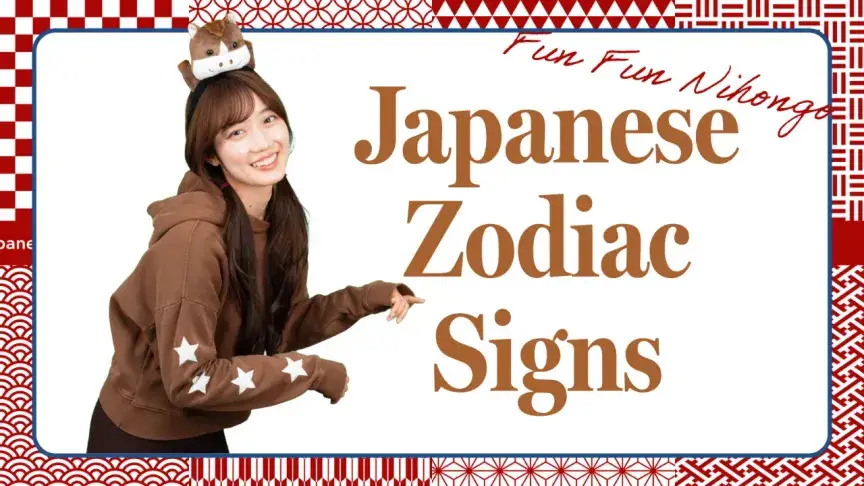
Around the New Year in Japan, animals appear everywhere — on decorations, calendars and greeting cards. These animals come from the Japanese zodiac, known as eto. In this article, we introduce the 12 zodiac signs from a Fun Fun Nihongo video, with simple notes to help you understand how zodiac kanji differ from everyday Japanese.
目次
This article is based on a video by Fun Fun Nihongo, our Japanese learning content series.
What Is the Japanese Zodiac?
In Japan, the zodiac is called eto (干支). It uses a cycle of 12 animals, with one animal assigned to each year. Around the New Year, people often talk about their zodiac animal or see it used in seasonal designs.
The 12 Japanese Zodiac Signs
子
- ね ne
rat
The zodiac kanji 子 is read as ne here, but in daily Japanese it usually means “child” (ko). When talking about the zodiac, people often say nezumi doshi (“Year of the Rat”).
丑
- うし ushi
cow
丑 is mainly used for the zodiac. In everyday Japanese, cows are written as 牛, using a different kanji.
寅
- とら tora
tiger
The zodiac kanji 寅 is specific to the zodiac, while 虎 is used for tigers in everyday writing. You may still see 寅 in names or traditional expressions, even outside zodiac contexts — for example, in Tora-san, one of the most popular movie series in Japanese history.
卯
- う u
rabbit
Although the zodiac kanji 卯 is read as u, people usually say usagi doshi in conversation, using the everyday word うさぎ.
辰
- たつ tatsu
dragon
The zodiac kanji 辰 is different from 竜 or 龍, which are more common in daily writing. 竜 and 龍 can be read as tatsu or ryū depending on the word. All refer to dragons, but the zodiac uses its own special form.
巳
- み mi
snake
In the zodiac, snake is written as 巳. In daily Japanese, snakes are usually written as 蛇 and read as hebi.
午
- うま uma
horse
The zodiac kanji 午 is unique to the zodiac when it means “horse.” In everyday Japanese, horses are written as 馬. Learners may recognize 午 from words like gozen (午前/a.m.) and gogo (午後/p.m.), where it has a completely different meaning.
未
- ひつじ hitsuji
sheep
The zodiac kanji 未 is different from 羊, which is used for sheep in daily writing.
申
- さる saru
monkey
In the zodiac, monkey is written as 申. In everyday Japanese, monkeys are written as 猿.
酉
- とり tori
rooster
The zodiac kanji 酉 refers specifically to a rooster (a male chicken). In daily Japanese, 鳥 is used as the general word for birds, while 鶏 refers to chickens. The zodiac uses 酉 as a symbolic form rather than the everyday kanji.
戌
- いぬ inu
dog
The zodiac kanji 戌 is only used for the zodiac. In everyday Japanese, dogs are written as 犬.
亥
- い i
boar
The zodiac uses 亥 for boar. In daily Japanese, boar is usually written as 猪 or いのしし. Japan uses a boar rather than a pig for this sign.
Useful Phrases
私は〇年生まれです。
- Watashi wa 〇-nen umare desu.
I was born in (year).
A simple way to talk about your birth year when zodiac signs come up.
あなたの生まれた年の干支は何ですか?
- Anata no umareta toshi no eto wa nan desu ka?
What is your zodiac animal?
This question is often heard in casual conversation around the New Year.
Find your zodiac sign by your birth year below.
| Japanese Zodiac | Birth Years |
|---|---|
| 子 ne (Rat) | 1924, 1936, 1948, 1960, 1972, 1984, 1996, 2008, 2020 |
| 丑 ushi (Ox) | 1925, 1937, 1949, 1961, 1973, 1985, 1997, 2009, 2021 |
| 寅 tora (Tiger) | 1926, 1938, 1950, 1962, 1974, 1986, 1998, 2010, 2022 |
| 卯 usagi (Rabbit) | 1927, 1939, 1951, 1963, 1975, 1987, 1999, 2011, 2023 |
| 辰 tatsu (Dragon) | 1928, 1940, 1952, 1964, 1976, 1988, 2000, 2012, 2024 |
| 巳 mi (Snake) | 1929, 1941, 1953, 1965, 1977, 1989, 2001, 2013, 2025 |
| 午 uma (Horse) | 1930, 1942, 1954, 1966, 1978, 1990, 2002, 2014, 2026 |
| 未 hitsuji (Sheep) | 1931, 1943, 1955, 1967, 1979, 1991, 2003, 2015, 2027 |
| 申 saru (Monkey) | 1932, 1944, 1956, 1968, 1980, 1992, 2004, 2016, 2028 |
| 酉 tori (Rooster) | 1933, 1945, 1957, 1969, 1981, 1993, 2005, 2017, 2029 |
| 戌 inu (Dog) | 1934, 1946, 1958, 1970, 1982, 1994, 2006, 2018, 2030 |
| 亥 i (Boar) | 1935, 1947, 1959, 1971, 1983, 1995, 2007, 2019, 2031 |
Quick Tip
Zodiac animals often appear on New Year cards (nengajō), at shrines and in seasonal decorations. Even if you don’t remember all 12, recognizing a few can help you follow conversations during the holiday season.
Follow Us on Social Media
Want more fun Japanese learning content? We post weekly videos, quizzes, and cultural tips across multiple platforms!
Fun Fun Nihongo
Instagram
Threads
Facebook
TikTok
YouTube

Performer, Fun Fun NihongoKotone is a Tokyo University of Foreign Studies graduate, where she majored in Philippine Studies. After studying abroad in Brunei and interning at a startup in Malaysia, she now works as a model while continuing to explore the world.
X (Formerly Twitter): @kotonefromjapan